Continuity
Is there an unbroken path?
Whether a path or surface forms an unbroken whole — among the earliest spatial concepts a child acquires.
- Reasoning
- 2D Maze, 3D Maze
- Planning
- Pipe

Do MLLMs share the topological intuition that humans build?
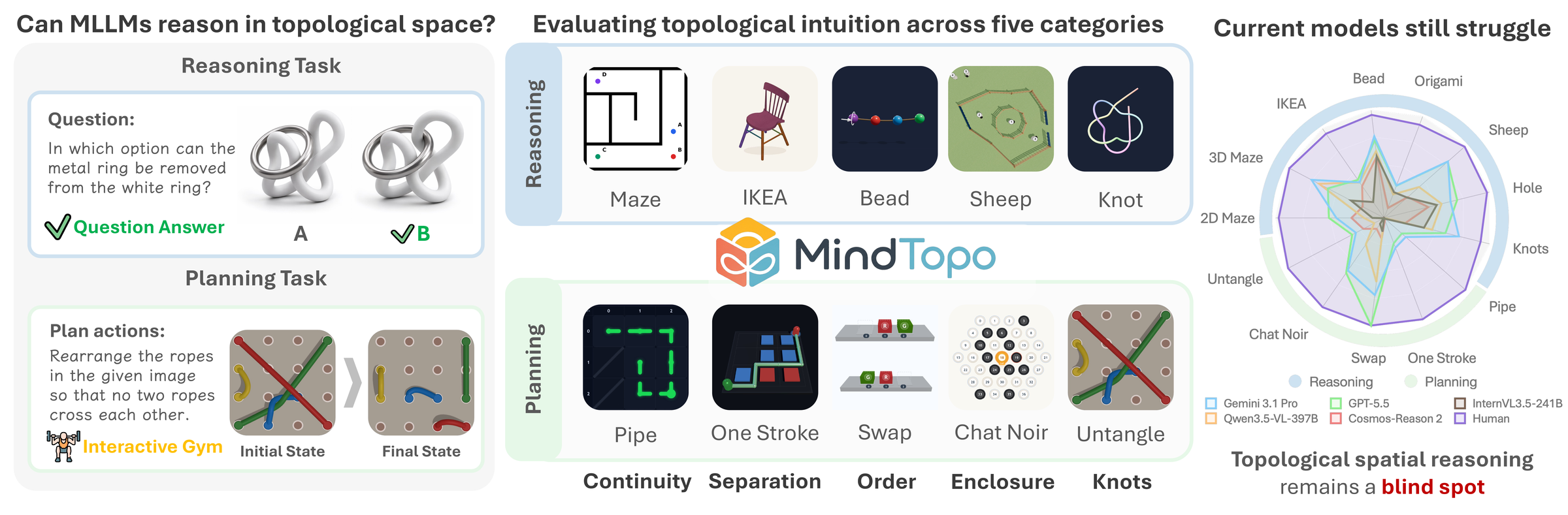
Key Takeaway: Frontier models can recognize a topological relation in a static scene, but they cannot maintain or operate on it across an action sequence.
Topological properties are the spatial properties that survive continuous deformation. A rope can be bent, stretched, or coiled, but whether it is knotted does not change. MindTopo organizes them into five Piagetian primitives and probes each at two cognitive levels — reasoning over a static rendered scene, and planning inside an interactive environment.
Is there an unbroken path?
Whether a path or surface forms an unbroken whole — among the earliest spatial concepts a child acquires.
One whole, or distinct parts?
The complement of proximity, and the prerequisite for any reasoning beyond an undifferentiated whole.
Which comes before which?
The sequential arrangement of elements along a path, tracked through a transformation of the scene.
What is inside, what is outside?
The inside/outside relation induced by a closed boundary — the Jordan curve theorem, and the holes in a solid.
Truly knotted, or merely tangled?
The "mother structure" that coordinates every other topological relation: crossings, linking, and knotting.
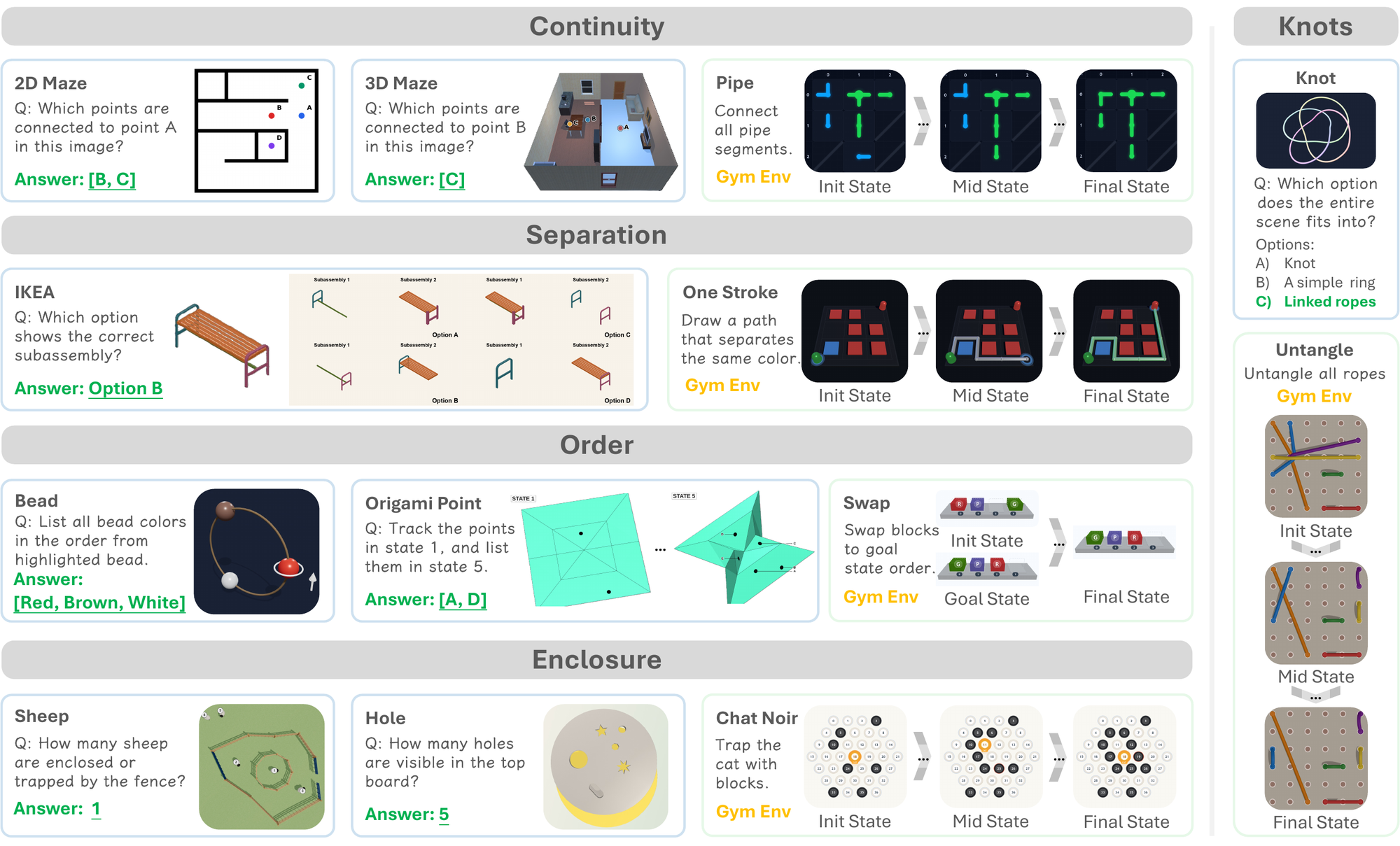
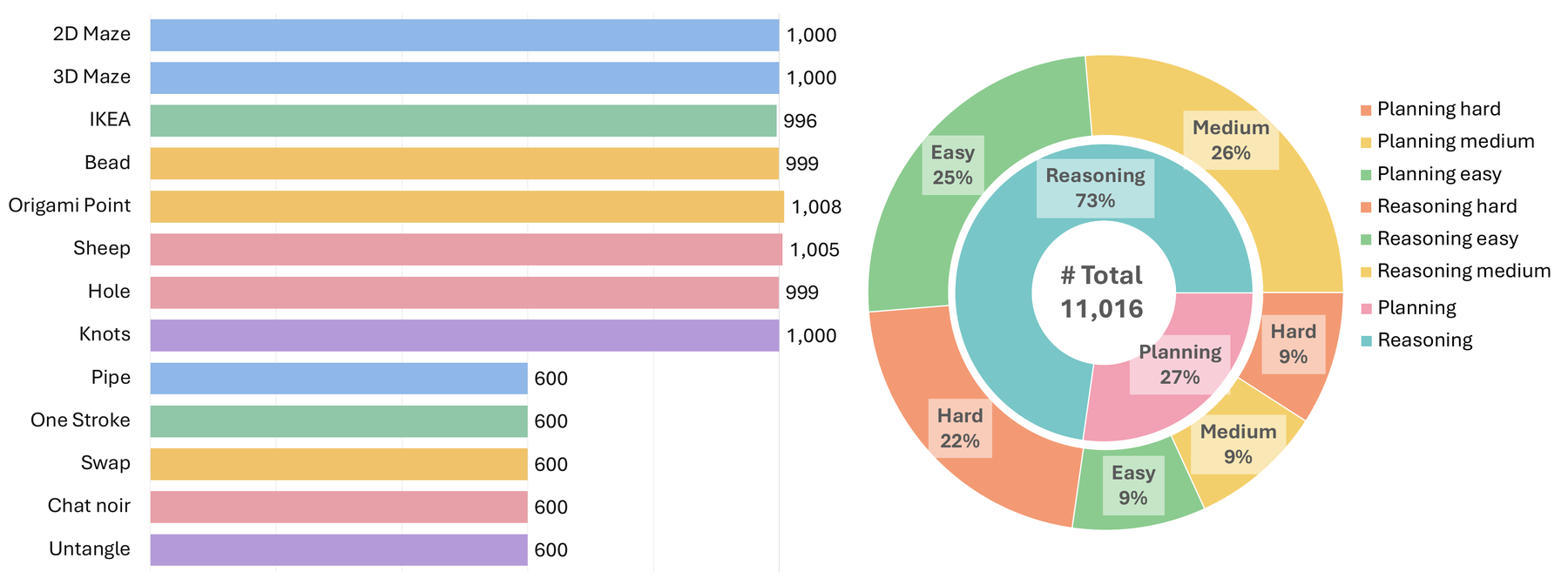
Accuracy (%) on the 13 MindTopo tasks, grouped by the five topological properties. Overall, Reasoning and Planning are unweighted means over the 13, 8 and 5 tasks respectively. Every model recognizes topology far better than it acts on it.
Click a column header to sort · scroll the table sideways to see every task
| Model | Summary | Continuity | Separation | Order | Enclosure | Knots | ||||||||||
|---|---|---|---|---|---|---|---|---|---|---|---|---|---|---|---|---|
| Overall↕ | Reasoning↕ | Planning↕ | 2D Maze↕ | 3D Maze↕ | Pipe↕ | IKEA↕ | One Stroke↕ | Bead↕ | Origami Point↕ | Swap↕ | Sheep↕ | Hole↕ | Chat Noir↕ | Knots↕ | Untangle↕ | |
| Gemini 3.1 Flash Lite | 36.31 | 50.84 | 13.06 | 21.90 | 60.30 | 0.00 | 42.47 | 0.00 | 66.97 | 36.70 | 12.80 | 61.00 | 55.00 | 25.60 | 62.40 | 26.90 |
| Gemini 3.1 Pro | 53.54 | 60.00 | 43.20 | 44.10 | 75.60 | 26.56 | 39.80 | 29.43 | 75.90 | 32.00 | 71.70 | 78.60 | 63.00 | 58.90 | 71.00 | 29.40 |
| GPT-5.4 mini | 25.47 | 35.20 | 9.90 | 20.40 | 30.10 | 0.00 | 36.24 | 0.00 | 59.86 | 21.73 | 15.60 | 29.25 | 57.98 | 26.10 | 26.00 | 7.80 |
| GPT-5.5 | 54.13 | 57.74 | 48.33 | 50.90 | 58.60 | 21.67 | 42.67 | 25.00 | 72.37 | 31.75 | 100.00 | 78.21 | 69.26 | 61.70 | 58.20 | 33.30 |
| InternVL-3.5-241b-a28b | 21.78 | 32.74 | 4.26 | 10.80 | 34.50 | 1.20 | 17.80 | 0.00 | 57.30 | 25.40 | 12.80 | 28.30 | 50.00 | 6.70 | 37.80 | 0.60 |
| Nemotron Nano 12B v2 VL | 21.90 | 31.63 | 6.34 | 18.30 | 25.20 | 0.50 | 41.00 | 0.60 | 41.50 | 24.50 | 13.90 | 18.00 | 59.70 | 1.70 | 24.80 | 15.00 |
| Gemma-4-31b-it | 25.50 | 39.74 | 2.71 | 26.50 | 55.80 | 7.50 | 18.80 | 0.00 | 66.37 | 45.24 | 0.00 | 50.35 | 49.90 | 0.00 | 5.00 | 6.06 |
| Qwen3.5-VL-397B | 34.94 | 44.34 | 19.90 | 18.72 | 67.77 | 0.00 | 39.76 | 0.00 | 62.19 | 23.21 | 59.50 | 42.99 | 54.49 | 29.70 | 45.60 | 10.30 |
| Cosmos-Reason2 | 23.18 | 30.74 | 11.10 | 30.10 | 22.40 | 0.00 | 35.74 | 2.20 | 56.96 | 9.82 | 19.40 | 29.05 | 41.82 | 12.20 | 20.00 | 21.70 |
| BAGEL-7B | 17.66 | 27.80 | 1.44 | 7.30 | 33.30 | 0.00 | 21.18 | 0.00 | 17.42 | 13.69 | 0.00 | 34.73 | 57.98 | 0.00 | 36.80 | 7.20 |
| ThinkMorph-7B | 14.83 | 24.10 | 0.00 | 8.20 | 31.10 | 0.00 | 21.18 | 0.00 | 17.22 | 11.81 | 0.00 | 20.00 | 55.89 | 0.00 | 27.40 | 0.00 |
| Random Chance | 9.49 | 13.27 | 3.45 | 11.12 | 22.83 | 0.00 | 19.94 | 0.00 | 8.43 | 10.07 | 8.89 | 10.31 | 8.41 | 1.67 | 15.01 | 6.67 |
| Human | 97.40 | 95.77 | 100.00 | 97.18 | 98.62 | 100.00 | 94.37 | 100.00 | 95.77 | 91.94 | 100.00 | 99.06 | 97.65 | 100.00 | 91.55 | 100.00 |
Highlighted cells mark the best evaluated model in that column. Random Chance and Human are reference rows and are excluded from that comparison.
If you find our work useful in your research, please cite:
@misc{ge2026mindtopo,
      title={MindTopo: Can Foundation Models Reason in Topological Space?},
      author={Yunfei Ge and Anbang Liu and Qineng Wang and Johnalbert Garnica and Jianwen Lyu and Zihan Wang and Reuben Tan and Jianfeng Gao and Ruohan Zhang and Yining Hong and Jiajun Wu and Manling Li},
      year={2026},
      url={https://mind-topo.github.io/},
}